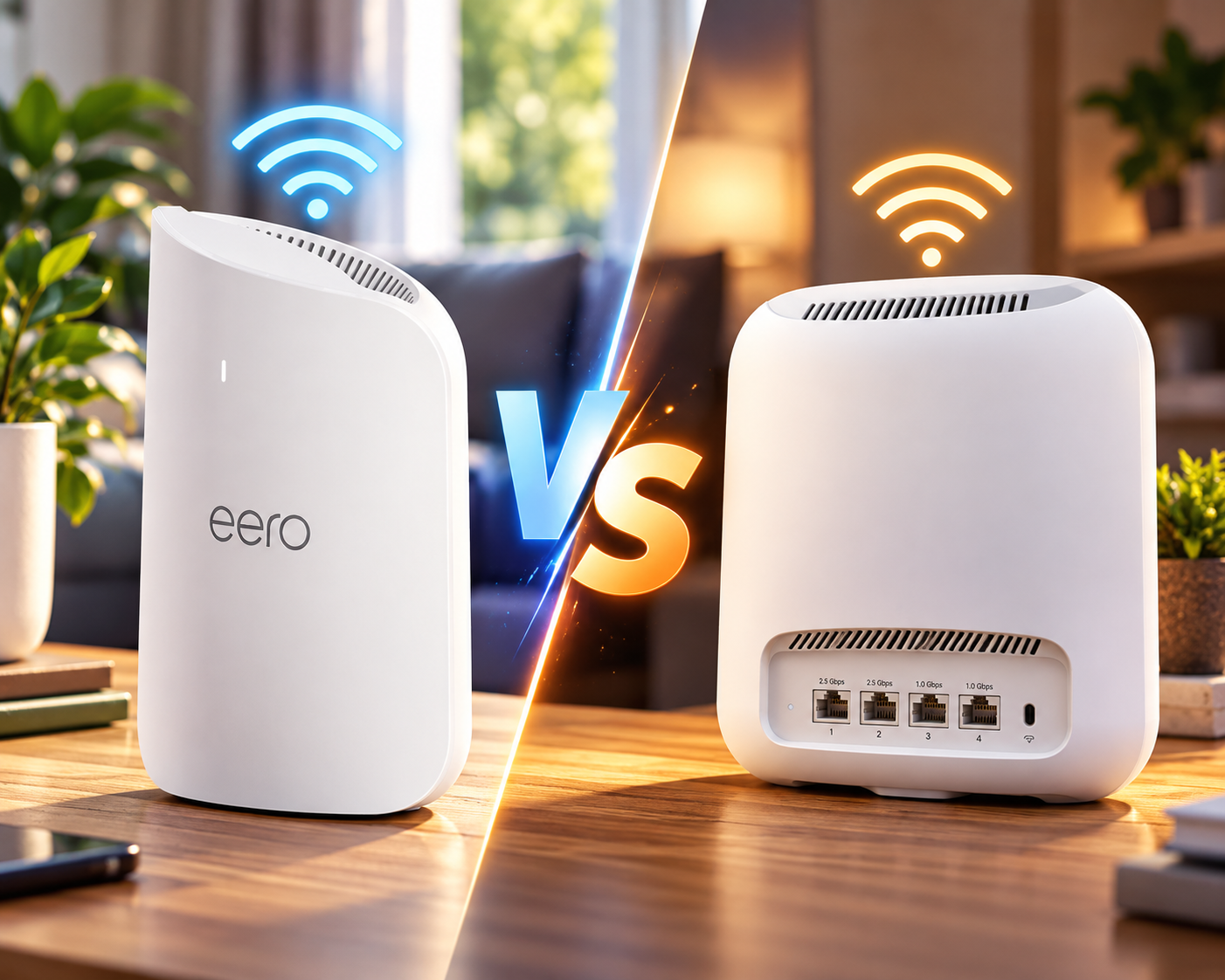
A fast internet plan does not automatically mean fast Wi-Fi in every room. As homes fill up with smart TVs, security cameras, phones, laptops, gaming systems, and other connected devices, the router behind the network becomes increasingly important.
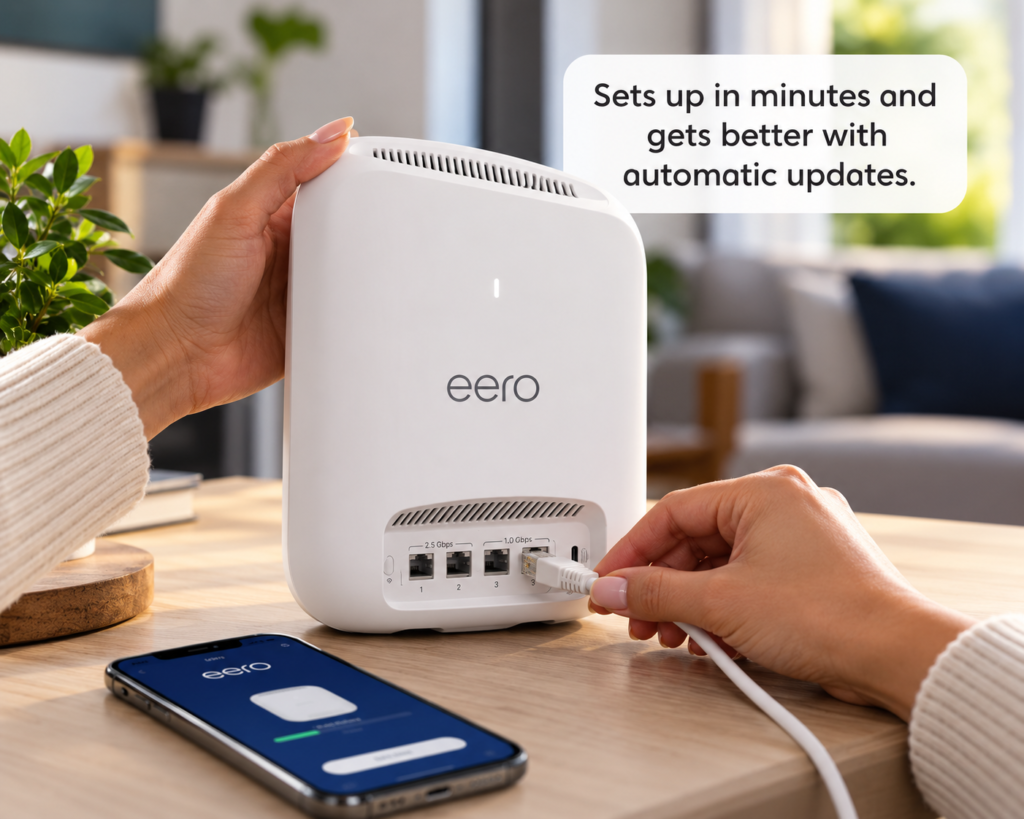
That is where the Amazon eero Pro 7 and Amazon eero Max 7 come in. Both are tri-band Wi-Fi 7 mesh routers designed for demanding home networks. They support the 2.4 GHz, 5 GHz, and 6 GHz bands, can work as either the gateway or an extender in an eero mesh network, and offer modern Wi-Fi 7 technologies such as Multi-Link Operation (MLO). However, they are not simply two versions of the same router. The eero Pro 7 is the more balanced choice for households that want multi-gig Wi-Fi 7 performance without automatically stepping up to eero’s highest-end hardware. It supports internet plans up to 5 Gbps, has two 5 GbE Ethernet ports, delivers advertised wireless speeds up to 3.9 Gbps, covers up to 2,000 square feet per unit according to eero’s current US shop listing, and supports 200+ connected devices.
Our Top Picks at a Glance
⭐eero Pro 7 — Best for Most Multi-Gig Wi-Fi 7 Homes
The eero Pro 7 hits an appealing middle ground between next-generation performance and practicality. It supports internet plans up to 5 Gbps and includes two auto-sensing 5 GbE Ethernet ports. Its advertised maximum wireless speed is up to 3.9 Gbps, while each unit is designed to handle 200+ connected devices.That combination makes the Pro 7 particularly interesting for busy households where several people may be streaming, gaming, working from home, making video calls, or using smart-home devices simultaneously.
Best suited for:
- Multi-gig internet households
- Streaming and online gaming
- Work-from-home setups
- Homes with many connected devices
- Buyers upgrading to Wi-Fi 7
- Users who do not need 10 GbE networking
eero Pro 7 vs eero Max 7 Comparison Table-
| Feature | Amazon eero Pro 7 | Amazon eero Max 7 |
|---|---|---|
| Wi-Fi Standard | Wi-Fi 7 | Wi-Fi 7 |
| Wi-Fi Bands | Tri-band: 2.4, 5 & 6 GHz | Tri-band: 2.4, 5 & 6 GHz |
| Internet Plans | Up to 5 Gbps | Up to 10 Gbps |
| Advertised Wireless Speed | Up to 3.9 Gbps | Up to 4.3 Gbps |
| Advertised Wired Speed | Up to 4.7 Gbps | Up to 9.4 Gbps |
| Ethernet Ports | 2 × 5 GbE | 2 × 10 GbE + 2 × 2.5 GbE |
| Advertised Coverage, 1 Unit | Up to 2,000 sq. ft.* | Up to 2,500 sq. ft. |
| Connected Devices | 200+ | 250+ |
| Multi-Link Operation (MLO) | Yes | Yes |
| Zigbee Support | Yes | Yes |
| Thread Support | Yes | Yes |
| Matter Controller | Yes | Yes |
| Mesh Capability | Yes | Yes |
| Best For | Most demanding multi-gig homes | Maximum performance & 10 GbE networks |
How We Tested and Compared
1. Wi-Fi performance potential: We compared the supported Wi-Fi standard, tri-band configuration, published wireless speeds, and Wi-Fi 7 capabilities such as Multi-Link Operation.
2. Wired networking: Ethernet connectivity is one of the largest differences between these models. We compared the Pro 7’s two 5 GbE ports with the Max 7’s two 10 GbE and two 2.5 GbE ports.
3. Coverage and device capacity: We examined eero’s published coverage figures and supported device counts to understand what type of household each router is intended to serve.
4. Everyday use: Specifications alone do not determine which product makes more sense. We considered common activities such as 4K streaming, gaming, working from home, video calls, smart-home connectivity, and homes where many devices are online simultaneously.
1. Amazon eero Pro 7 Review-

Amazon eero Pro 7 Tri-Band Mesh Wi-Fi 7 Router(Home Wi-Fi for Faster Streaming) – Review
- Modern Wi-Fi 7 technology
- Up to 2,000 sq. ft. coverage
- Supports plans up to 5 Gbps
- Expandable eero mesh ecosystem
- Clean, antenna-free appearance
- Premium price versus basic routers
- One unit may not cover large homes
- Wi-Fi 7 benefits require compatible devices
- Advanced users may want more granular controls
Wi-Fi 7 for a Busy Connected Home
One of the biggest reasons to consider the eero Pro 7 is Wi-Fi 7. Modern households can have far more connected devices than they realize. Smartphones and laptops are only the beginning. Add smart TVs, streaming boxes, security cameras, video doorbells, tablets, speakers, game consoles, smart thermostats, plugs, lights, and appliances, and the network can become crowded quickly.
What We Like
Excellent Balance of Performance and Practicality
The Pro 7 provides many of the benefits buyers expect from a premium Wi-Fi 7 system without immediately moving into the Max 7’s more specialized 10 GbE territory. For households with multi-gig internet but no need for 10 Gigabit Ethernet, that can make the Pro 7 a more logical fit.
Wi-Fi 7 Support
Support for Wi-Fi 7 gives the Pro 7 greater relevance for households buying newer phones, laptops, and other devices. Even if most of your current equipment uses an older Wi-Fi standard, a Wi-Fi 7 router can provide a foundation for future upgrades.
5 GbE Ethernet
Two 5 GbE ports are a significant advantage for users moving beyond traditional Gigabit networking. They give the Pro 7 enough wired capacity to make sense alongside faster internet services and compatible multi-gig networking equipment.
Where It Falls Short
Only Two Ethernet Ports : This is probably one of the clearest limitations for power users. Two 5 GbE ports are fast, but there are only two of them. A household with multiple wired PCs, consoles, network storage devices, or other Ethernet equipment may need an additional switch.
It Cannot Match the Max 7’s 10 GbE Connectivity : The Pro 7 supports internet plans up to 5 Gbps, whereas the Max 7 is designed for plans reaching 10 Gbps and includes 10 GbE Ethernet connectivity. If you already have—or seriously plan to build—a 10 GbE home network, the Pro 7 could become the limiting choice.
Wi-Fi 7 Benefits Depend on Your Devices : A Wi-Fi 7 router does not automatically make every device dramatically faster. To access the newest Wi-Fi 7 capabilities, your client devices also need compatible hardware. Homes dominated by older Wi-Fi devices may see less immediate benefit from upgrading.
2. Amazon eero Max 7 Review-
Amazon eero Max 7 Mesh Wi-Fi 7 Router – Review
- Next-generation Wi-Fi 7
- Supports plans up to 10 Gbps
- Up to 2,500 sq. ft. coverage
- Expandable mesh architecture
- Designed for 250+ devices
- Premium purchase price
- Overkill for basic internet plans
- Large homes may need extra units
- Best benefits require newer devices
Wi-Fi 7 Built for High-Bandwidth Homes
The eero Max 7 uses the Wi-Fi 7 standard and supports the 2.4 GHz, 5 GHz, and 6 GHz bands. For a busy household, that additional network capability can matter. Imagine a home where several people are simultaneously streaming 4K video, playing online games, downloading large files, joining video meetings, backing up data, and operating dozens of smart-home devices.
What We Like
Excellent Multi-Gig Wired Connectivity
The combination of two 10 GbE and two 2.5 GbE Ethernet ports is one of the Max 7’s biggest advantages. For advanced home networks, those ports offer substantially more flexibility than the Pro 7’s two-port configuration.
Built for Very Fast Internet Plans
Support for internet plans up to 10 Gbps gives the Max 7 significant headroom for households with access to high-end multi-gig fiber services.You may not need that capacity today, but buyers already investing in faster networking equipment may appreciate having room to grow.
Wi-Fi 7 Support
The Max 7 gives buyers access to the newest generation of Wi-Fi technology, including MLO for compatible devices. That makes it especially attractive for users gradually replacing older devices with newer Wi-Fi 7 hardware.
Where It Falls Short
Its Extra Capability May Be Overkill
This is the biggest issue for many buyers. A household with a 500 Mbps or 1 Gbps internet plan, relatively few devices, and no 10 GbE hardware may never take meaningful advantage of the Max 7’s most impressive capabilities. Buying more performance than you need is not necessarily harmful, but it can make it difficult to justify paying more.
10 GbE Requires Compatible Hardware
Having a 10 GbE port does not automatically give every connected device 10 Gbps performance. To take advantage of that capability, the rest of your network—including internet service, Ethernet adapters, switches, cabling, storage, and other equipment—needs to support appropriate speeds.
eero Pro 7 vs eero Max 7: Head-to-Head Comparison-
Wi-Fi Technology: Both Offer Wi-Fi 7 :
There is no generational advantage here: both routers support Wi-Fi 7.
Both are tri-band systems using:
- 2.4 GHz
- 5 GHz
- 6 GHz
They also support Wi-Fi 7 technologies such as Multi-Link Operation.
Wireless Speed: 3.9 Gbps vs 4.3 Gbps :
Eero advertises wireless speeds up to:
eero Pro 7: 3.9 Gbps
eero Max 7: 4.3 Gbps
On paper, the Max 7 is faster.
Internet Plan Support: Up to 5 Gbps vs 10 Gbps :
This is a more substantial difference.
The eero Pro 7 supports internet plans up to 5 Gbps, while the eero Max 7 supports plans up to 10 Gbps.
For most households, 5 Gbps is already an enormous amount of internet capacity.
Who Should Buy Which? eero Pro 7 vs eero Max 7-
Choose the eero Pro 7 If You Want Wi-Fi 7 Without Going Overboard
The eero Pro 7 makes the most sense for buyers who want a high-performance Wi-Fi 7 mesh system but do not have a specific need for 10 GbE networking.
Its two 5 GbE Ethernet ports and support for internet plans up to 5 Gbps already put it well beyond the requirements of many typical home networks.
You Have a Fast Internet Plan, but Not 10 Gbps
If your internet connection falls comfortably within the Pro 7’s supported range, moving to the Max 7 solely for its higher internet-plan ceiling may provide little practical benefit. This is especially important if most of your devices connect wirelessly. Your router should have enough capacity for your connection, but paying for networking capability you cannot use does not necessarily improve your everyday experience.
Your Household Streams on Multiple Devices
A busy evening might involve a movie playing in the living room, another TV streaming upstairs, someone watching videos on a tablet, and several phones connected in the background.
You Play Games but Don’t Have a 10 GbE Network
Gaming alone is not a reason to jump automatically to the Max 7.
Choose the eero Max 7 If Your Network Demands More
The eero Max 7 becomes easier to justify when your requirements extend beyond ordinary wireless networking. Its strongest advantages are not simply a higher advertised Wi-Fi speed. They are its 10 GbE connectivity, four Ethernet ports, higher internet-plan support, greater advertised coverage, and additional device capacity.
You Have—or Plan to Get—Internet Above 5 Gbps
This is one of the clearest reasons to consider the Max 7. The Pro 7 is positioned for internet plans up to 5 Gbps, while the Max 7 supports plans up to 10 Gbps. If ultra-fast fiber service is already available at your address and you intend to subscribe to a plan above the Pro 7’s supported range, the Max 7 is the more appropriate platform.
You Are Building a 10 GbE Home Network
This is where the Max 7 has one of its strongest advantages. With two 10 GbE ports plus two 2.5 GbE ports, it offers much more flexibility for high-performance wired networking.
This is where the Max 7 has one of its strongest advantages.
How to Choose the Right Wi-Fi 7 Mesh Router
1. Start With Your Internet Speed
Your internet plan is one of the easiest places to start. The eero Pro 7 is designed to support internet plans up to 5 Gbps, while the eero Max 7 extends that support up to 10 Gbps.
2. Don’t Confuse Internet Speed With Wi-Fi Speed
Internet speed and local Wi-Fi capability are related, but they are not the same thing.
3. Check Whether Your Devices Support Wi-Fi 7
Both the eero Pro 7 and Max 7 support Wi-Fi 7.
However, you need compatible client devices to take full advantage of the newest Wi-Fi 7 capabilities.
4. Count Your Ethernet Devices
Ethernet connectivity is one of the most important differences between these two routers.

Frequently Asked Questions: eero Pro 7 vs eero Max 7
1. What Is the Main Difference Between the eero Pro 7 and eero Max 7?
The biggest difference is not simply wireless speed—it is the amount of networking capacity and wired connectivity each router provides.
2. Are the eero Pro 7 and eero Max 7 Both Wi-Fi 7 Routers?
Yes. Both models support Wi-Fi 7 and operate across the 2.4 GHz, 5 GHz, and 6 GHz bands.
They also support Wi-Fi 7 technologies such as Multi-Link Operation (MLO).
3. Will Older Wi-Fi Devices Work With These Routers?
Yes. You do not need to replace every wireless device in your home when upgrading to an eero Wi-Fi 7 system.
4. Which One Is Better for a Large Home?
The Max 7 has the higher manufacturer-rated coverage per unit, at up to approximately 2,500 square feet, while eero’s current US Pro 7 product listing states up to approximately 2,000 square feet per unit.
5. Can I Add More eero Units Later?
Yes. One of the major advantages of the eero platform is its mesh design.
The Verdict: eero Pro 7 vs eero Max 7-
The Amazon eero Pro 7 and eero Max 7 have most of the same features that matter most in a modern home network. Both have tri-band Wi-Fi 7 connectivity (2.4 GHz, 5 GHz, and 6 GHz), Multi-Link Operation support, expandable eero mesh networking, and smart-home technologies such as Zigbee, Thread, and Matter. The real difference is how much networking capacity you actually need.
Designed for households that want a powerful Wi-Fi 7 upgrade, but don’t necessarily want to step into 10 GbE networking, the eero Pro 7 is a good choice. Two 5 GbE Ethernet ports, advertized wireless speeds of up to 3.9 Gbps, coverage of up to 2,000 square feet per unit, and support for 200+ connected devices already provide ample capacity for a modern connected home with support for internet plans of up to 5 Gbps.
The eero Max 7 takes it even further. It is rated to handle internet plans of up to 10 Gbps, features two 10 GbE and two 2.5 GbE Ethernet ports, advertized wireless speeds of up to 4.3 Gbps, coverage of up to 2,500 square feet per unit, and support for 250+ connected devices.
Final Takeaway
The eero Pro 7 and eero Max 7 are aimed at buyers who want modern Wi-Fi 7 networking, but they serve different levels of network demand.
The Pro 7 provides the core features many high-performance households are looking for: Wi-Fi 7, multi-gig networking, 5 GbE Ethernet, strong device capacity, smart-home integration, and expandable mesh coverage.
The Max 7 builds on that foundation with considerably stronger wired-networking hardware, including 10 GbE, more Ethernet ports, a higher supported internet-plan ceiling, and additional capacity.